Edward Deleu

Research & projects

Projects

My work applies computation, from first-principles electronic-structure methods to machine learning, to questions in materials science and condensed-matter physics. The projects below trace an arc: data-driven modeling of magnetic materials, numerical studies of topology in disordered quantum Hall systems, the strain-tunable electronic structure of two-dimensional semiconductors, and, in my PhD, optically active defects in hexagonal boron nitride (hBN).

Figures open at full resolution. “More detail” expands each project’s full description.

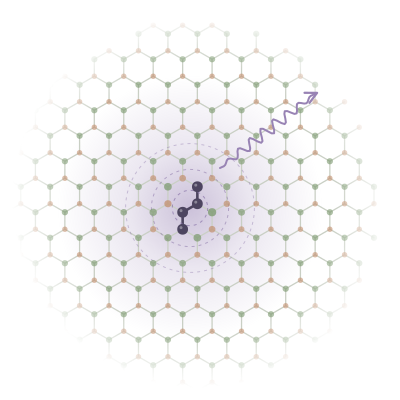
Schematic of a honeycomb hBN lattice with a four-carbon defect at its center, surrounded by a shaded exciton envelope with dashed contours, and a wavy arrow for an emitted photon.
Schematic of my PhD focus: an exciton (shaded) bound to a four-carbon defect in monolayer hBN, emitting a single photon. Illustrative, not computed data.
Before Princeton Princeton · undergraduate Stanford · PhD Pedestrian counting (2021) 2021 Pedestrian counting Magnetic core loss (2023–24) 2023–24 Magnetic core loss GAN colorization (2024) 2024 GAN colorization Quantum Hall topology (2024–25) 2024–25 Quantum Hall topology Characterization lab (2025) 2025 Characterization lab TMD strain thesis (2025–26) 2025–26 TMD strain thesis MLIPs for TMDs (2026) 2026 MLIPs for TMDs hBN defect emitters (2026–) 2026– hBN defect emitters
  1. Before Princeton
  2. 2021Pedestrian counting
  3. Princeton · undergraduate
  4. 2023–24Magnetic core loss
  5. 2024GAN colorization
  6. 2024–25Quantum Hall topology
  7. 2025Characterization lab
  8. 2025–26TMD strain thesis
  9. 2026MLIPs for TMDs
  10. Stanford · PhD
  11. 2026–hBN defect emitters
How the projects connect, from early machine learning through quantum and materials physics to my PhD. Select a project to jump to it. machine learning characterization materials & quantum physics

Materials & quantum physics

The central thread of my research: how atomic-scale structure, strain, and disorder determine electronic and optical properties. These projects run from defect emitters in hBN, through first-principles and experimental studies of 2D semiconductors, to topology in model quantum Hall systems.

PhD researchStanford MSE · Prof. Felipe Jornada · 2026–present

Excited-state pathways of carbon defects in hBN

A first-principles study of how four-carbon defects in monolayer hexagonal boron nitride (hBN) rearrange, and whether one single-photon emitter can be converted into another.

Current questionCan a single carbon–nitrogen exchange convert C₂C₂-3, a candidate for the yellow emitter (~575 nm), into C₂C₂-trans, a candidate for the blue B center (436 nm)? And is the barrier accessible thermally, or only under optical excitation?
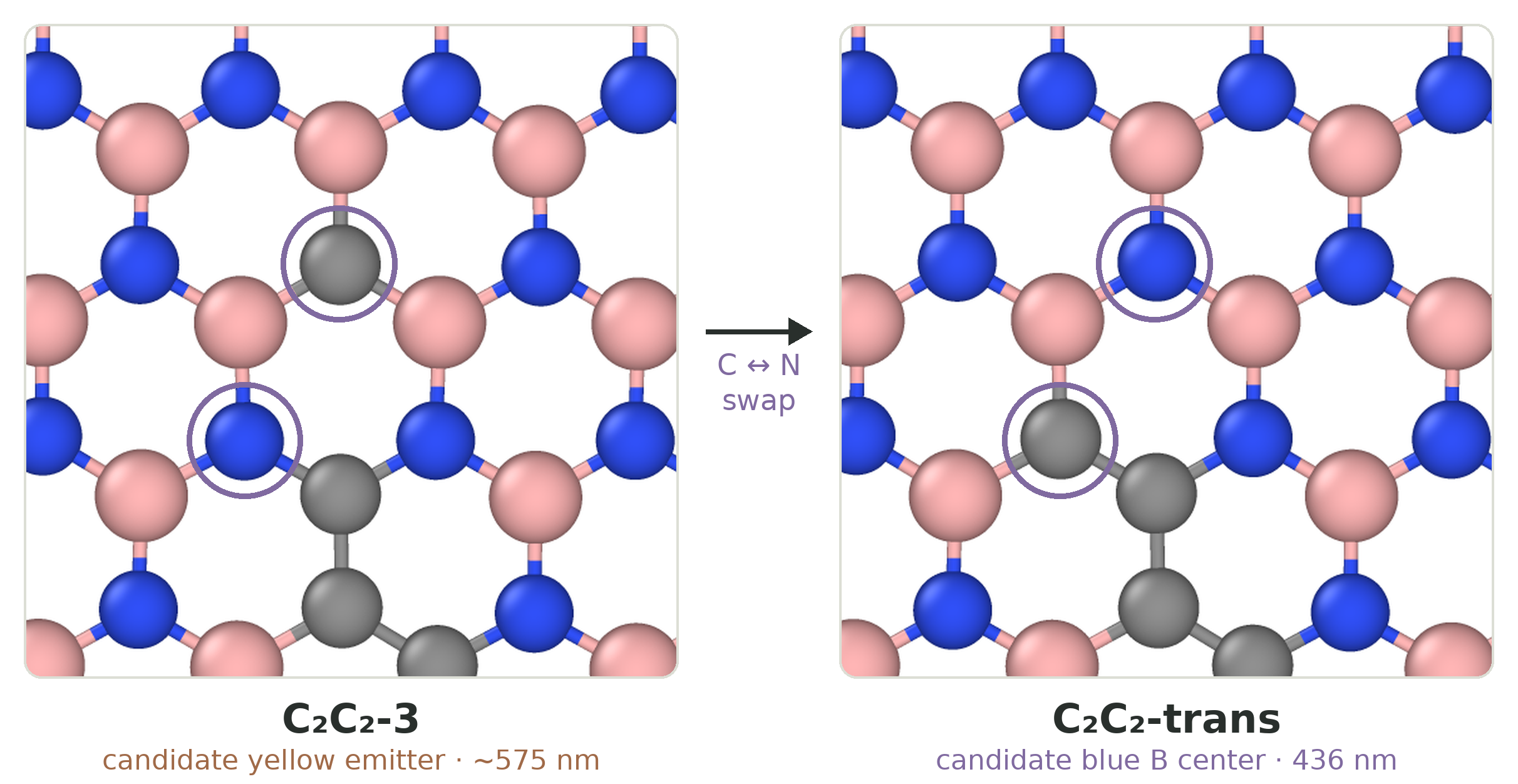
Two close-ups of the hBN lattice (boron pink, nitrogen blue, carbon gray). Left, C2C2-3: a three-carbon chain plus one separate carbon. Right, C2C2-trans: a continuous four-carbon zigzag chain. The two exchanged sites are circled.
C₂C₂-3 (left) and C₂C₂-trans (right) differ by exchanging one carbon and one nitrogen atom (circled). Boron, pink; nitrogen, blue; carbon, gray.
More detailLess detail

BackgroundSingle-photon emitters, light sources that release one photon at a time, are building blocks for quantum communication and sensing. Point defects in hBN are among the brightest emitters that operate at room temperature, and carbon-related defects have been linked to several of them. Emitters in hBN are also observed to blink, shift in wavelength, or switch between emission states over time, possibly through structural changes, and the atomic origins of most of them are still debated.

ApproachC₂C₂-3 and C₂C₂-trans have the same composition and differ only by one C ↔ N exchange, yet they are candidates for emitters of very different color. I compute minimum-energy pathways between them to find the barrier for this exchange, first on the ground-state energy surface and then in excited states, to test whether light could drive the conversion.

MethodsGround-state and triplet pathways use density functional theory (PBE, Quantum ESPRESSO) with the nudged elastic band and string methods on large supercells, run on national supercomputing resources. Starting paths are built with image-dependent pair potentials (IDPP) and screened with single-point calculations. The next stage uses GW and the Bethe–Salpeter equation (BerkeleyGW) to describe excitons and, through excited-state forces, to relax structures and follow reaction paths on the excited-state surface.

Why it mattersA computed barrier would show whether this exchange can explain observed emitter changes, and whether it could be driven deliberately. More broadly, GW–BSE excited-state forces are among the most accurate first-principles tools for excited states but are rarely applied to defect reactions; this project tests them on a realistic case.
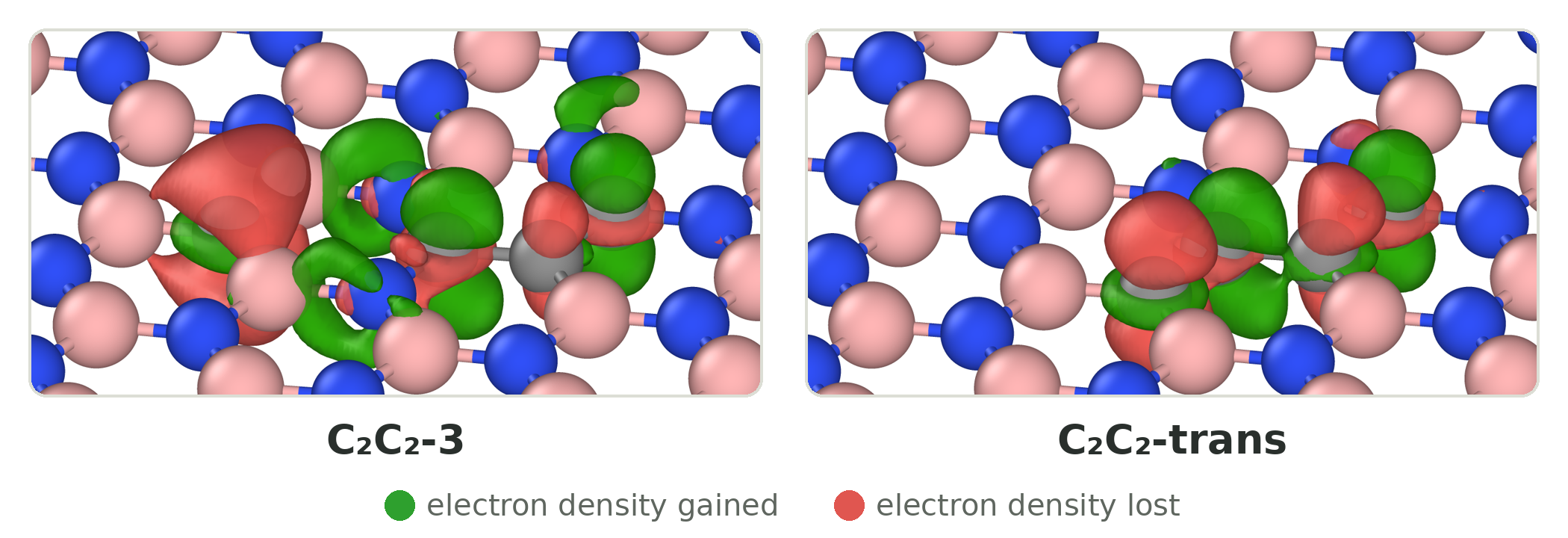
Close-ups of the two defects with green and red isosurfaces showing where electron density increases and decreases from the ground state to the triplet state; in both, the changes sit on and around the carbon atoms.
Charge-density difference between the lowest triplet state and the singlet ground state (constrained-occupation DFT, PBE), localized on the carbon cluster in both configurations. Green, density gained; red, density lost.

DFT · Nudged elastic band · String method · IDPP · GW · Bethe–Salpeter equation · Excited-state forces · Quantum ESPRESSO · BerkeleyGW · HPC
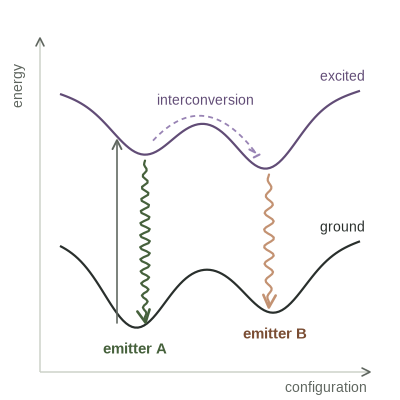
Energy curves for the ground and excited states along a configuration coordinate. Absorption at emitter A is followed by a dashed path over a barrier on the excited-state curve to emitter B; wavy arrows show each emitter releasing a photon of a different color.
Schematic of the idea: after excitation at configuration A, the defect may cross a barrier on the excited-state surface to configuration B, and each configuration emits light of a different color. Illustrative, not computed data.
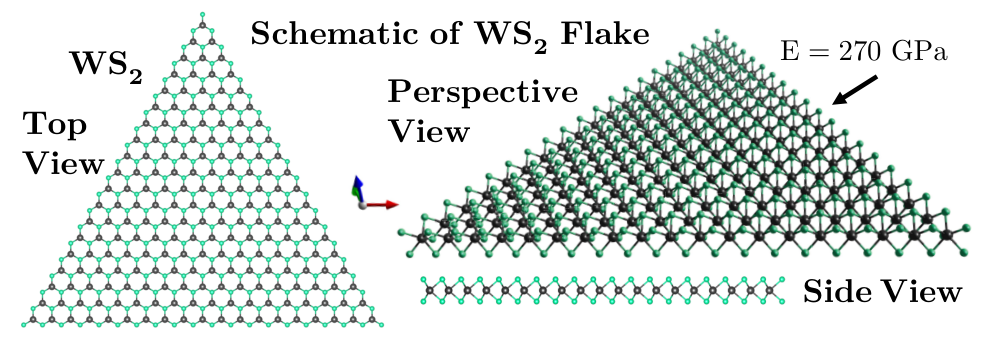
Atomic model of a tungsten disulfide flake in top, perspective, and side views.
Schematic of a triangular monolayer WS₂ flake in top, perspective, and side views. From the thesis poster.

Senior thesisPrinceton ECE · Prof. Saien Xie · 2025–26

Strain engineering of transition metal dichalcogenides

A combined first-principles and experimental study of how mechanical strain tunes the band structure of monolayer group-VI transition metal dichalcogenides (TMDs).

More detailLess detail

BackgroundMonolayer TMDs are direct-bandgap 2D semiconductors that tolerate large mechanical strain, making strain a continuous handle for tuning their electronic and optical properties in flexible devices.

ApproachI performed density functional theory calculations for MoS₂, MoSe₂, MoTe₂, WS₂, and WSe₂ under biaxial strain from −10% to +10%, and complemented them with uniaxial tensile-strain experiments on monolayer WS₂ using elongation and bending, tracking the optical bandgap with photoluminescence spectroscopy.

FindingsWS₂ shows the strongest bandgap tunability; sulfides are consistently more tunable than selenides and tellurides; and the response is dominated by the conduction band. Bending experiments reached a maximum A-exciton shift of −48.3 meV and, in a separate run, a gauge factor of −19.6 meV/%, consistent with the predicted trends. Building on both, the thesis proposes a WS₂/MoSe₂ heterostructure as a platform for strain-tunable optoelectronics.

VASP · DFT, including hybrid functionals · Photoluminescence spectroscopy · Uniaxial strain (elongation, bending)

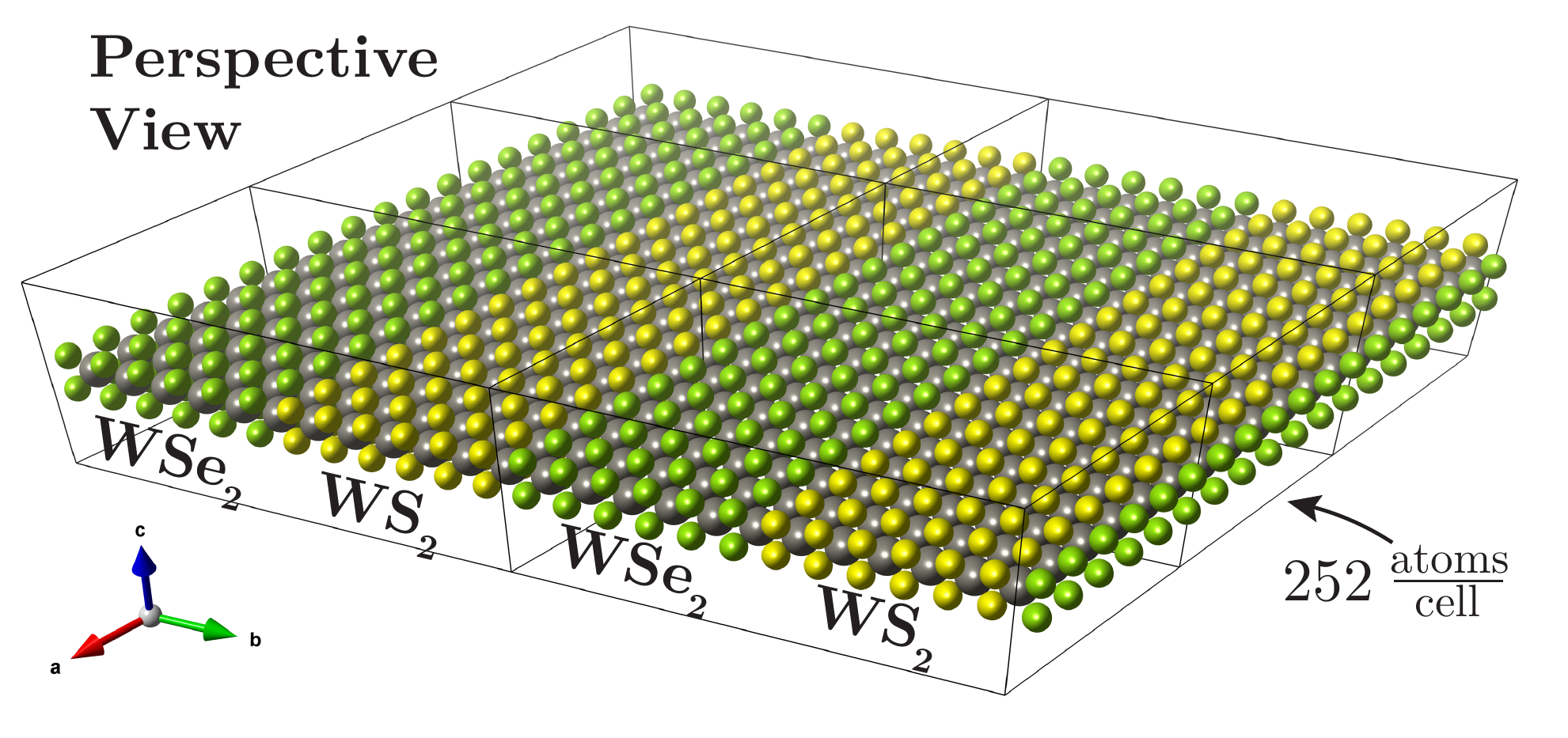
Perspective view of a relaxed 252-atom WS2/WSe2 lateral heterostructure, shown as a repeated supercell with alternating WSe2 and WS2 regions.
A 252-atom WS₂/WSe₂ lateral heterostructure, relaxed with TensorNet-MatPES-r²SCAN, the most accurate machine-learning potential tested, and shown as a repeated supercell. From the report (Fig. 2).

Course projectPrinceton CBE/MSE 423 · Prof. Andrew Rosen · Spring 2026

Machine-learning potentials for strained TMDs

An evaluation of machine-learning interatomic potentials (MLIPs) as faster alternatives to DFT for structural relaxation and strained-bandgap modeling in monolayer TMDs.

More detailLess detail

BackgroundDFT becomes costly for large supercells and dense strain grids, which limits computational studies of TMD alloys, heterostructures, and strain. MLIPs promise near-DFT accuracy at a fraction of the cost.

ApproachI benchmarked several recent MLIPs against DFT and experiment on the five TMDs studied in my thesis, used the most accurate model to relax a 252-atom WS₂/WSe₂ lateral heterostructure, and compared two machine-learning workflows against DFT for bandgaps under biaxial strain.

FindingsAll MLIPs gave structures of DFT quality, with average RMSDs below 0.1 Å relative to experimental unit cells. TensorNet-MatPES-r²SCAN was the most accurate and relaxed the heterostructure in 55 optimization steps. A density-of-states model with bandgap prediction (PET-MAD-DOS) captured qualitative trends but not quantitative values, whereas MLIP relaxation followed by a single static DFT calculation closely reproduced the all-DFT strain–bandgap trends.

MLIPs · DFT benchmarking · Strain–bandgap modeling · Lateral heterostructures

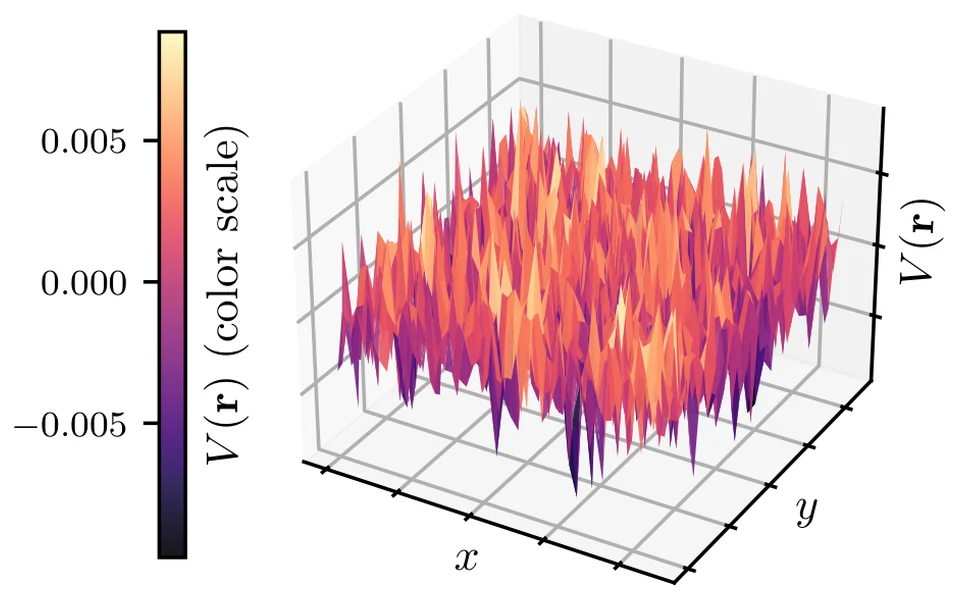
Surface plot of a random disorder potential used in the simulations.
One random disorder potential V(r) of the kind used to simulate electrons in the lowest Landau level.

ResearchPrinceton ECE 398 · Prof. Ravindra Bhatt · 2024–25

Chern number statistics in the lowest Landau level

A large-scale numerical study relating topology to energy-level statistics for electrons in the lowest Landau level with random disorder.

More detailLess detail

BackgroundIn the integer quantum Hall effect, extended states carry a nonzero Chern number, a topological invariant, while localized states have zero Chern number. Random matrix theory offers a complementary, statistical description of the same spectrum.

ApproachI simulated disordered lowest-Landau-level systems with up to 2,048 states and computed a Chern number for every state. My Python, CuPy, and Numba pipelines ran on Princeton’s research computing clusters; over the full project they used about 447k CPU-hours and 7k GPU-hours.

FindingsLevel spacings cross over from Gaussian unitary ensemble statistics at the band center to Poisson statistics at the band edges. Restricting to states of the same Chern number reveals intermediate statistics, shaped by interspersed states with different Chern numbers and by repulsion between extended states. A manuscript with R. Samajdar and R. Bhatt is in preparation.

Python · CuPy / Numba · HPC (Slurm) · Random matrix theory · Scaling analysis

Microscopy & characterization

Coursework in experimental characterization, a complement to my computational work. One project reports hands-on measurements; the other reviews a specialized imaging technique.

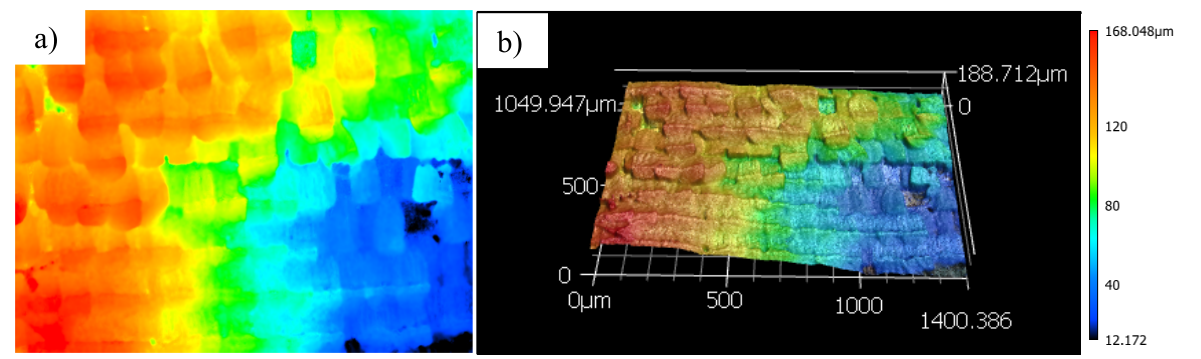
Butterfly-wing topography: a confocal height map and its 3D reconstruction.
Butterfly-wing scales imaged by confocal microscopy: (a) height map and (b) 3D reconstruction of a 1.40 × 1.05 mm area.

Course projectPrinceton MSE 505 · Prof. Nan Yao · Spring 2025

Materials characterization lab

A laboratory report on five characterization techniques, comparing what each reveals about structure and composition across length scales.

More detailLess detail

ApproachI used confocal laser-scanning microscopy for 3D topography, scanning electron microscopy with EDS for fine structure and elemental composition, X-ray diffraction for crystallography, and transmission electron and atomic force microscopy for nanoscale imaging. Butterfly-wing scales serve as a recurring sample.

PurposeImaging the same butterfly wing by confocal microscopy, SEM, and AFM shows how optical, electron, and scanning-probe methods differ in resolution, contrast, and sample preparation; XRD identified an unknown powder as a rutile–corundum mixture, and TEM imaged a standard specimen of sputtered gold particles. All measurements were performed at Princeton’s Imaging and Analysis Center.

Confocal · SEM / EDS · XRD · TEM · AFM

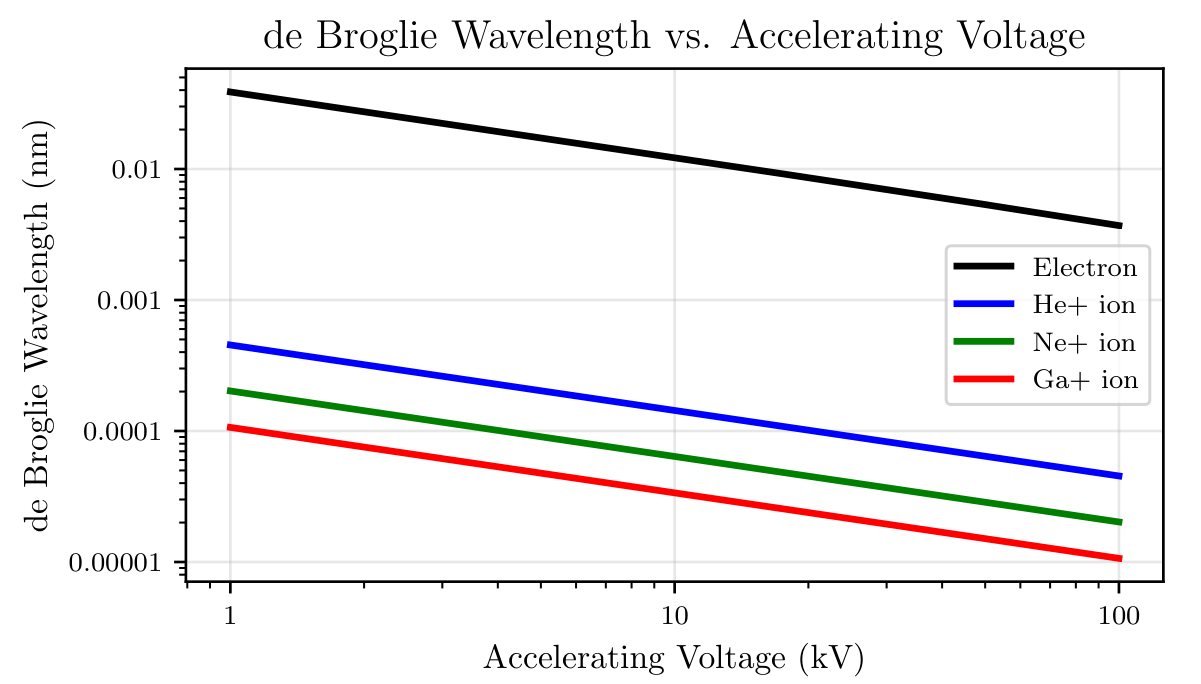
Plot comparing electron and ion wavelengths against accelerating voltage.
De Broglie wavelength of electrons and of He⁺, Ne⁺, and Ga⁺ ions versus accelerating voltage. At the same accelerating voltage, a helium ion’s wavelength is about 85 times shorter than an electron’s, one reason helium ion microscopy can image at high resolution.

Course projectPrinceton MSE 505 · Prof. Nan Yao · Spring 2025

Helium ion microscopy: a review

A literature review of helium ion microscopy (HIM), covering its instrumentation, imaging mechanisms, and analytical capabilities.

More detailLess detail

ScopeThe review traces the development of the technique, then covers the gas field ion source and ion optics; beam–sample interactions; imaging with secondary electrons, backscattered ions, and ionoluminescence; and analytical modes such as secondary-ion mass spectrometry, with comparisons to SEM. It closes with applications and an outlook.

NoteThis is a literature-based study; no HIM measurements were performed.

Ion optics · Beam–sample interactions · Imaging contrast · Analytical methods

Machine learning

Machine-learning projects, going back to my first publication. They built the data-driven skills I now apply to materials problems, such as the interatomic potentials in the TMD course project.

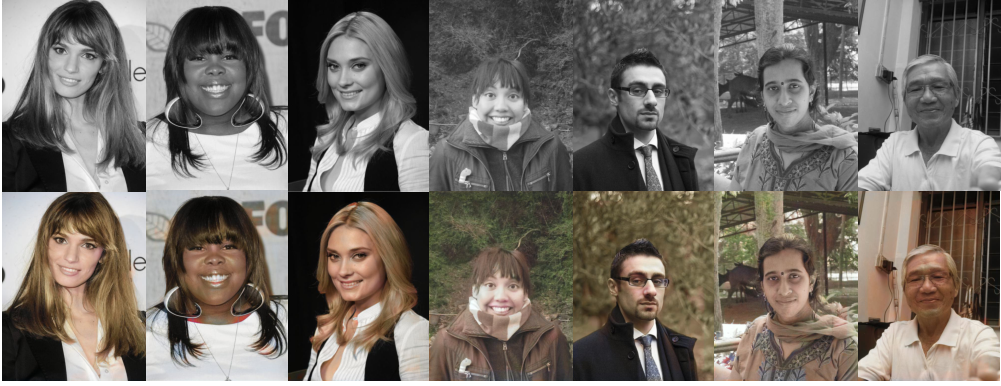
Grayscale portrait inputs above model-generated colorizations.
Grayscale portrait inputs (top row) and the GAN’s colorized outputs (bottom row).

Course projectPrinceton COS 429 · with Vishva Ilavelan · Fall 2024

Bias in GAN-based portrait colorization

A conditional Wasserstein GAN for colorizing grayscale portraits, analyzed for how training-data imbalance affects results across demographic groups.

More detailLess detail

BackgroundColorization is a generative image-to-image task. Because portrait datasets are often demographically imbalanced, a model’s output quality may vary across groups.

ApproachWe trained a conditional Wasserstein GAN on the AISegment portrait dataset and evaluated it on FairFace and other portrait datasets, comparing reconstruction errors across demographic groups.

FindingsDespite the imbalanced training data, reconstruction error was similar across the seven demographic groups in FairFace, and skin tones were colorized consistently. Errors concentrated in clothing, which the model rendered in muted neutral tones, and in cluttered backgrounds.

PyTorch · Conditional WGAN · Computer vision · Fairness evaluation

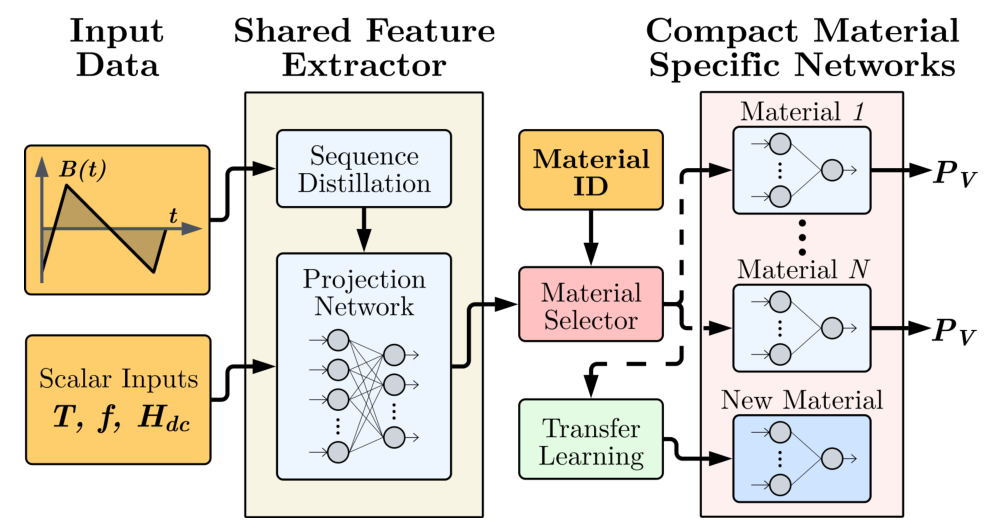
Diagram of a shared feature extractor feeding material-specific mapping networks.
Framework architecture: a shared feature extractor reads the flux waveform B(t) and operating conditions; compact material-specific networks predict core loss, and new materials are added by transfer learning.

ResearchPrinceton Andlinger Center · Prof. Minjie Chen · 2023–24

Multi-material magnetic core-loss modeling

A compact, modular neural-network framework that predicts magnetic core loss across materials and adapts to new ones with little data.

More detailLess detail

BackgroundCore loss in magnetic components depends on intertwined factors: temperature, frequency, DC bias, and waveform shape. Empirical models such as the Steinmetz equation have limited accuracy, and earlier neural-network approaches required a large model and dataset for each material.

ApproachI trained a shared transformer-based feature extractor on six materials from the open-source MagNet database (about 950k augmented sequences), with small material-specific networks mapping its features to core loss. New materials are added by transfer learning with the extractor held fixed.

FindingsEach material requires only 573 parameters beyond the 14,864-parameter shared network, with about 1.3% average error across soft ferrites; transfer learning reaches high accuracy with only hundreds of data points. The work was published at IEEE APEC 2024, and the poster received the Andlinger Center’s Undergraduate Presentation Award.

PyTorch · Transformers · Transfer learning · Optuna

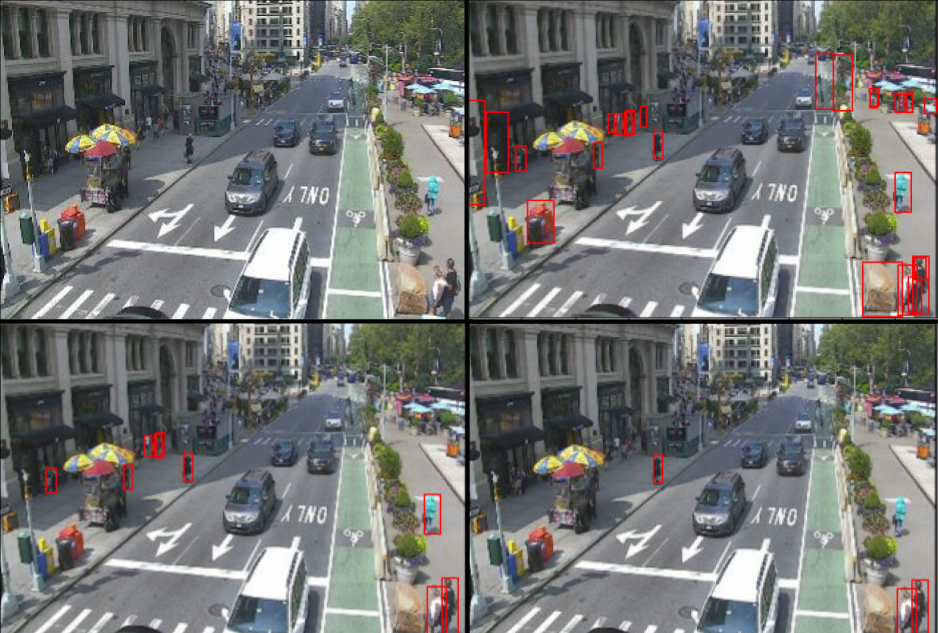
Manhattan traffic-camera frame with red boxes around pedestrians detected by the model.
Pedestrians detected (red boxes) in a Manhattan traffic-camera frame at this camera’s optimal confidence threshold, 0.45. The full figure also shows thresholds of 0.1 and 0.8.

ResearchRutgers School of Engineering · with S. Elez, A. Gadodia, K. Macvaugh, and G. Zhao · 2021

Deep learning for urban pedestrian counting

A deep-learning system that counts pedestrians in public traffic-camera images at five Manhattan intersections.

More detailLess detail

BackgroundCrowded sidewalks slow pedestrian travel and raise safety concerns, including theft and disease transmission. Location-based monitoring of foot traffic could help residents plan routes that avoid congestion.

ApproachWe used a Python web scraper to collect about 1,750 daytime and nighttime images from five 511NY traffic cameras in Manhattan, and hand-counted pedestrians in a random subset for ground truth. After comparing Haar cascade, HOG with a linear SVM, YOLOv3, SSD, and Faster R-CNN detectors, we selected a COCO-pretrained Faster R-CNN (ResNet-50, GluonCV), chose each camera’s confidence threshold by minimizing the mean percentage error, and mapped the results in MATLAB.

FindingsIn clear weather the system reached 75–83% accuracy during the day (78.8% on average) and 59–79% at night (69.8% on average), supporting the viability of camera-based pedestrian counting. The remaining errors stemmed mainly from low image resolution and false positives such as trash cans and streetlights. The work was presented virtually at the 2021 IEEE MIT Undergraduate Research Technology Conference.

Python · GluonCV · Faster R-CNN · Web scraping · MATLAB